Trying to finish a syllabus is nearly impossible. To put the pen down means to admit that your course can never be comprehensive – never conclusive. And when it comes to teaching the history of food (even in the U.S.), it feels impossible to press print. But here’s to beginning complex discussions about food somewhere!
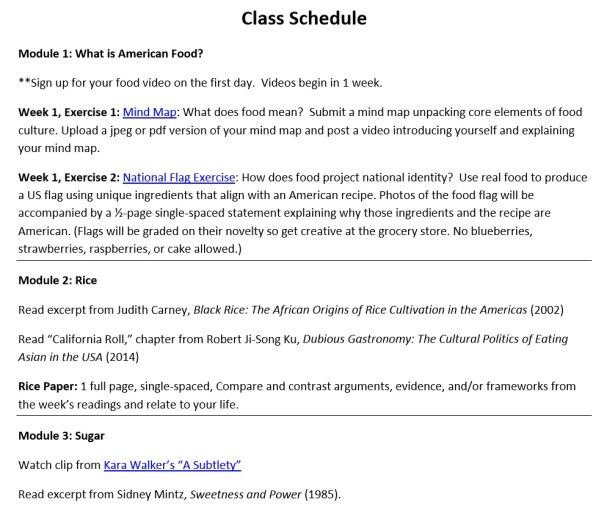
Here is a syllabus for an undergraduate American Studies course exploring transnational American food studies I designed to teach as a distance learning option at Purdue University in the spring of 2017. Having taught a distance learning course and wrestled with how to make meaningful connections with students via the Internet, I’ve tried to use technology and interactive exercises to still make food a medium for engaging with American history and culture critically.
While the course is organized around weekly readings regarding 11 key ingredients, I’ve incorporated assignments that will enable students to complete independent projects using both digital technology and oral history tools. One additional extra credit option allows students to “choose their own adventure” by documenting and analyzing an independent field trip to a site of food production and consumption wherever they are located.
Weeks have been organized around 11 key ingredients, with the ultimate goal of showing how there is no one American diet. Food ingredients have been arranged in a way to capture key national discussions chronologically, from rice and sugar in connection with colonialism and enslavement to coffee and wheat in regards to modern processes of fast food production and globalization.
See the reading and assignments schedule here at my Academia.edu page, where you can find the complete PDF version of the syllabus.
It was a painstakingly difficult process to narrow this course to 11 ingredients. What ingredients would you include in your course on American food histories? Any must-have readings on food history that I should include for my next course? Share them with me!
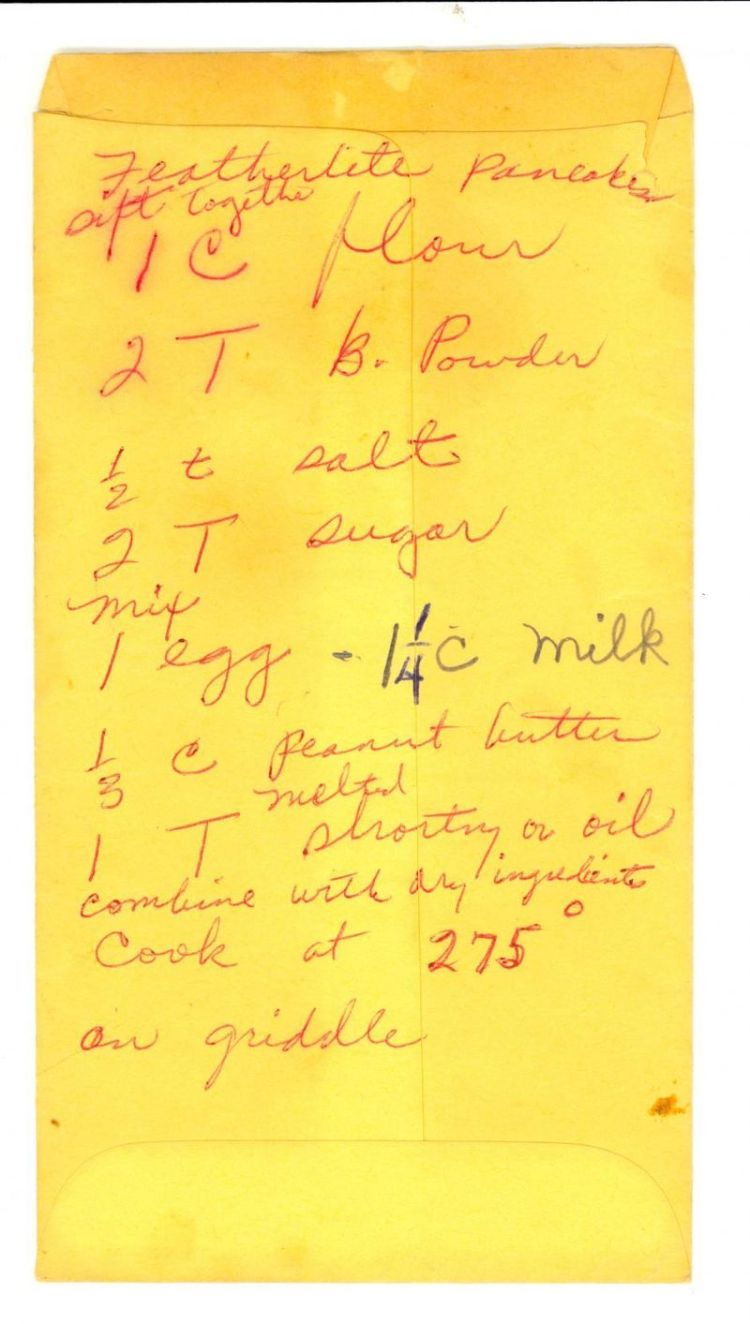
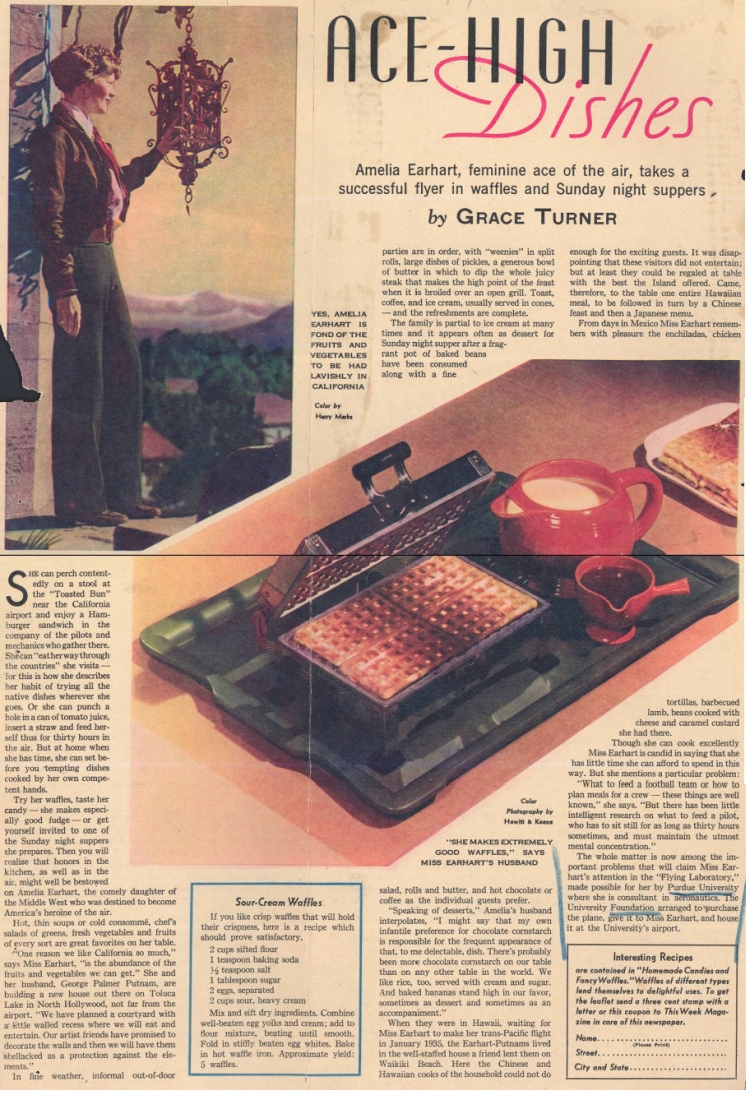
Happy Women’s History Month! Today we’re hitting the archives. Imagine a tip jar: Amelia Earhart’s Sour Cream Waffles versus Rosa Parks’s Peanut Butter Pancakes. Who’s the winner!? I feel a taste-test coming.
Rosa Parks’s Peanut Butter Pancakes
Click the image to see a larger version of this recipe at the Library of Congress.
Amelia Earhart’s Sour Cream Waffles
Click the image to see a larger version of this recipe at the Purdue University Archives.
A student in my course “American Bodies” thinks back critically on the class, arguing that American citizens are defined by group-specific stereotypes that create different experiences and further reinforce misconceptions:
“We discussed many different forms of bodies that have all had distinct social associations connected to them. For the most part, white men have dominated society, always being in power and having authority over others. Those with negative social associations have always been at a disadvantage and often have been restricted, whether that be socially or under very specific laws created by those in power. We discussed how people in power have tried to regulate and restrict those below them often for nothing more than their skin color….”
In my American Studies courses I ask students to construct a mind map with an accompanying essay reflecting back on the course. The assignment aims to secretly get students to think about a structural analysis of power.
For this assignment, students were asked to reimagine the course structure by choosing a few of the course readings, films, lectures, etc. and lumping them into new categories and linking these categories and topics. It might sound a bit confusing, abstract, or a little hippie granola for you, but when executed correctly produces beautiful, thought-provoking images that evidence students reflecting critically on the course material.
First I’m going to give you the assignment basics and then I’ll share some of the best mind maps and their essays from my Spring 2015 course I designed, “Blood, Bones, and Brains: 20th Century History of American Bodies.” (You can see the syllabus for that course on my Academia.edu page.)
Assignment Basics
I show them this mindmap as an example and tell them that the center of the mind map should be their overarching argument — each branch shooting out from the center should be a main theme, and then the smaller lines attached to those main theme branches should be their evidence to prove their argument. I use that mind map example because many others that you can find through Google are not intending to evidence an argument and, therefore, tend to be more descriptive brainstorming maps than a tool for visualizing a thesis.
However, unlike that mindmap example linked above, students are asked to build off the main theme branches with evidence from the course. These offshoots from the main themes can be organized in whatever fashion they want. Sometimes you’ll find clear linkages and in other cases huge messy clouds of connections. A brief 1-page explanatory essay accompanies the image in order to articulate the student’s argument and evidence why those themes, offshoots, and connections/linkages were selected. Students can create these mind maps whatever way they’d like — via 3D model, video, Powerpoint, drawn by hand, or using some of these programs.
Results
Student 1:
“My mind map is divided into the three units (Turn of the Century, World War Era, and Postwar) that made up our semester. Each unit is then divided into the topics of each class. Lastly, I added the distinct topics and concepts that we learned in class and discovered in the readings. In the middle of my mind map I drew a person to represent the common theme of our class, American bodies. I made him look kind of like a super hero because I feel like everything we learned throughout the semester makes the American body; no matter skin color, shape, class, race, a superhero….”
Student 2:
“It is not everyday when you think about people and their mindsets/values as “bodies”. When we start to think of bodies and how they are shaped and characterized by society, I realized how we start to perceive them. Bodies such as women, people of color, or those who are poor are seen as “weak”, “disabled”, and even not worth “saving”. These perceptions lead to the image they have on society. They are viewed as these things with the help of racism and sexism. Are these bodies really “free” in the Land of the Free and the Home of the Brave if they cannot even be seen as equal?
It was interesting to see that the typical “white, middle class male” wasn’t even deemed glorious if they were not muscular and well behaved gentleman of society. The actions that were/are taken on these people include laws, internalized/externalized judgments, and discrimination. Society chose to oppress those who weren’t fit for society. Women, people of color, and even “weak” men were oppressed without question and still are today. The progression of these topics led to dire consequences for society. Society was divided and there was a lack of trust for other groups and the government as a whole. This begs the question: “why?”. Why did we oppress and continue to oppress different groups of bodies?”
Student 3:
“The concept of the ideal body came from the readings: Modified Bodies, Bodies on Display, Regulating Bodies, and Bodies in Crisis. Each of these readings spoke about wanting to achieve the perfect or ideal body or of not having that ideal body (Regulating Bodies). Another strong theme was race. The race factor was in almost every one of our readings. It was what I would almost venture to say the main theme was of our class. It was everywhere which is appropriate since it is everywhere in everyday life….”
Student 4:
“Something that I came to understand is that the theme of Bodies on Display is perpetual, for ‘the gaze’ as you called it, is and will always be present. In this course, I was able to look at bodies from a new perspective. With my mind map I aimed to visualize essentially, how the themes we covered are interconnected. For example, a modified body is equally a body in pain and a body in conflict. Women who would change their images whether through make up, breast implants, or vaginal reconstruction (a topic covered in another class), would initially be bodies in a state of conflict, torn between what they believed to be true beauty and ugliness. Simultaneous they would be a body in pain, for just about all the modification process that we talked about came at some cost or risk….”
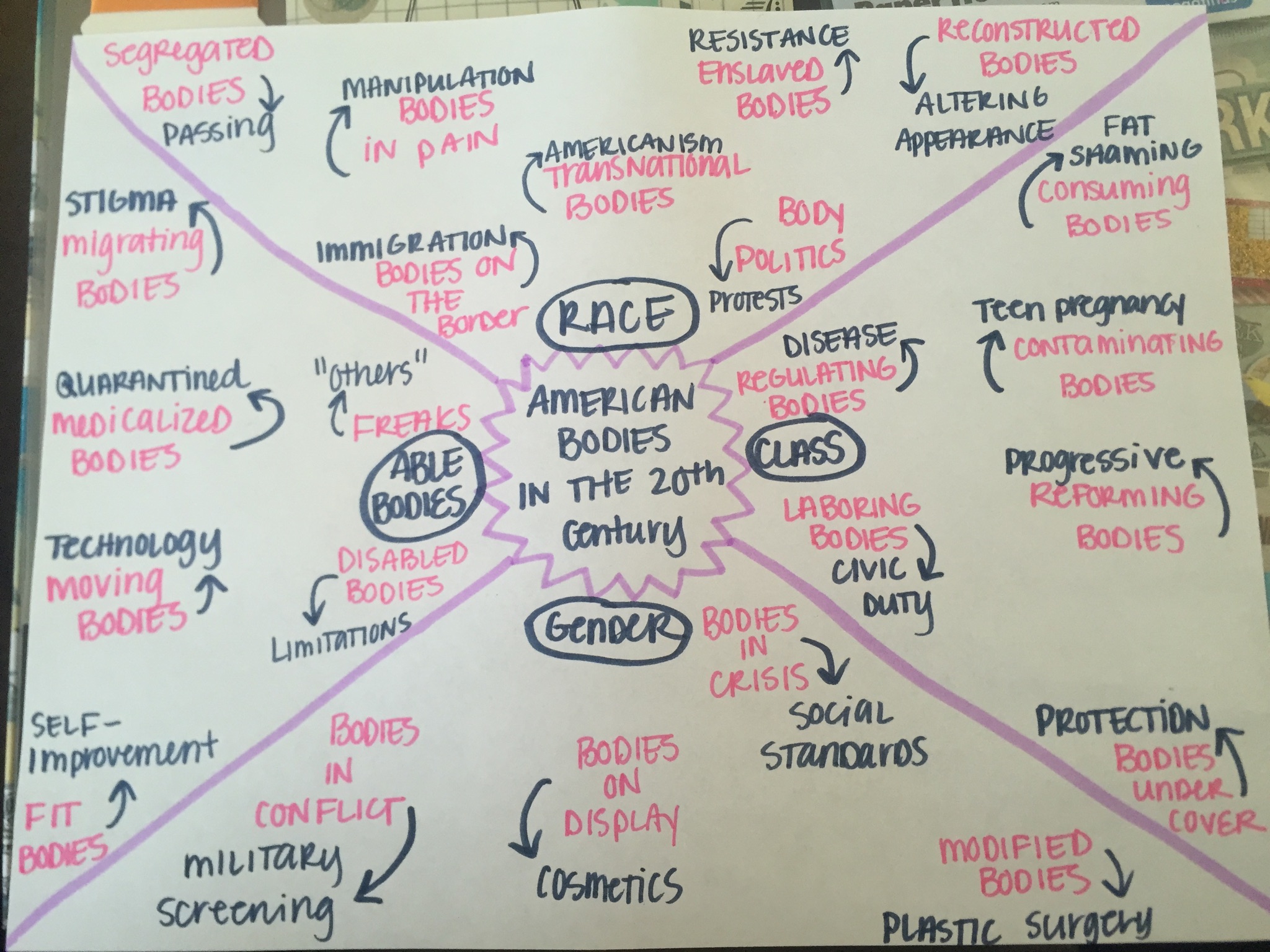
Student 5:
This student divided their mind map into quadrants: “When I went to first create my mind map, I knew I definitely wanted there to be certain divisions of demographics and then I wanted to place the readings, that related to that aspect of the body, into that category. I chose to divide the course into four different categories: race, class, gender, and able-bodies. Although these are just a few of many demographics, I feel like the readings fit nicely and evenly into those categories. While I have placed all of these readings into specific categories, they definitely, without question, overlap with one another in more ways than one. After dividing the readings into their corresponding areas of concentration, I then wrote a phrase arrowed off of the reading that explained one prominent aspect of the reading….”
Reflections
Ultimately, the assignment worked pretty well in getting students to explore the relationship between group identities and intersectionality. Having recently spoken with Julian Chambliss about his use of infographics in the classroom almost as research reports, I’m determined to find new ways of incorporating visual and experiential modes of communication and critical thinking into courses that moves beyond strictly reading and writing. Have other ideas? Share them with me!
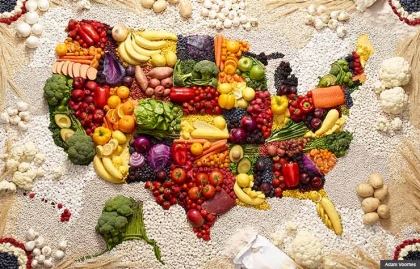
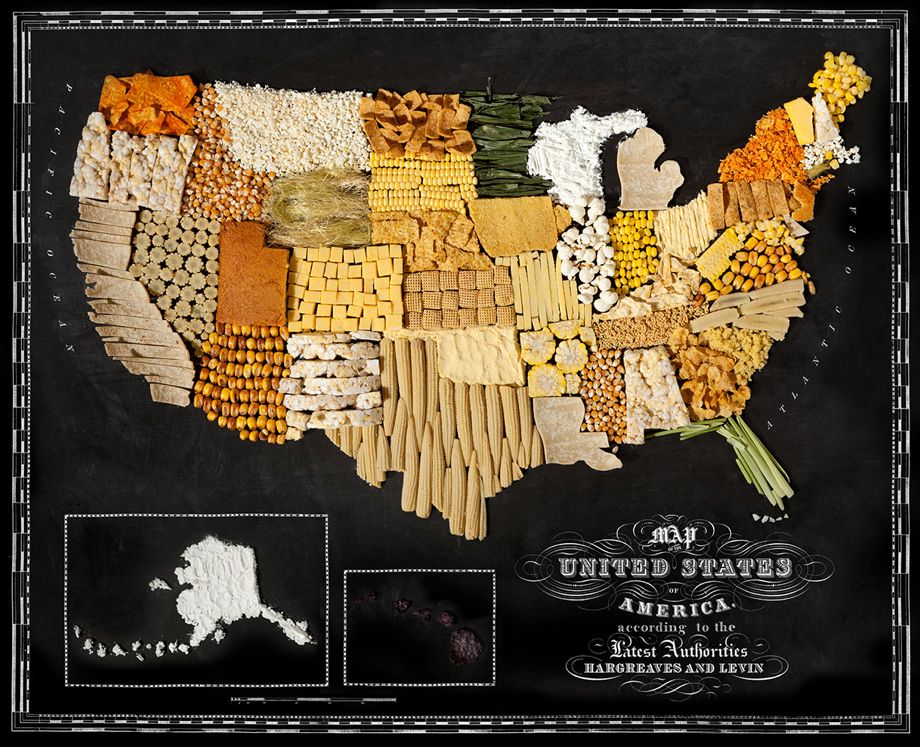
I’m in the throes of organizing a course for the American Studies program at Purdue on food studies – a class exploring the connections between food, identity, and place. Today’s visual inspirations are maps I’ve found trying to embed certain recipes within US regions and cities. What could you add to these maps? How would your map of US food culture differ?
For me, these are missing a fundamental food from my youth: pecans. I was raised in Leesburg, Georgia – a city with mostly suburbs that were rapidly created after nearby Albany was integrated to meet the demands of white flight in the 1960s.
My family moved there after our home (and thousands of others) were flooded during Tropical Storm Alberto in 1994, fueling new housing development in the largely rural Leesburg. When we moved to Leesburg, our middle-of-nowhere suburb was surrounded by pecan orchards. Miles and miles of pecan trees about 20 feet tall, in rigidly aligned rows as far as you could see.
But this landscape changed in the 10 years I lived there from about 1995 to 2005. Food culture shifted – nuts became more expensive and too caloric and fatty for mid-1990s diet fads. The price of land spiked – the push for new housing developments made pecan orchards prime candidates for new suburbs.
When I left for college, few pecan farms remained. Identical houses were built equidistant every 3-4 trees. “Who would want to live in such a maniacal grid?” I thought from our largely wooded suburb (woods that would be demolished to build more houses in the coming decades).
Needless to say, I would add pecans and walnuts to Georgia on my map. When I was young, I could find them raw in snack bowls on my grandma’s dinner table, sprinkled atop the sweet potato souffle on Thanksgiving, and forming the crunchy crust of a pecan pie…not to mention, right outside the kitchen window.
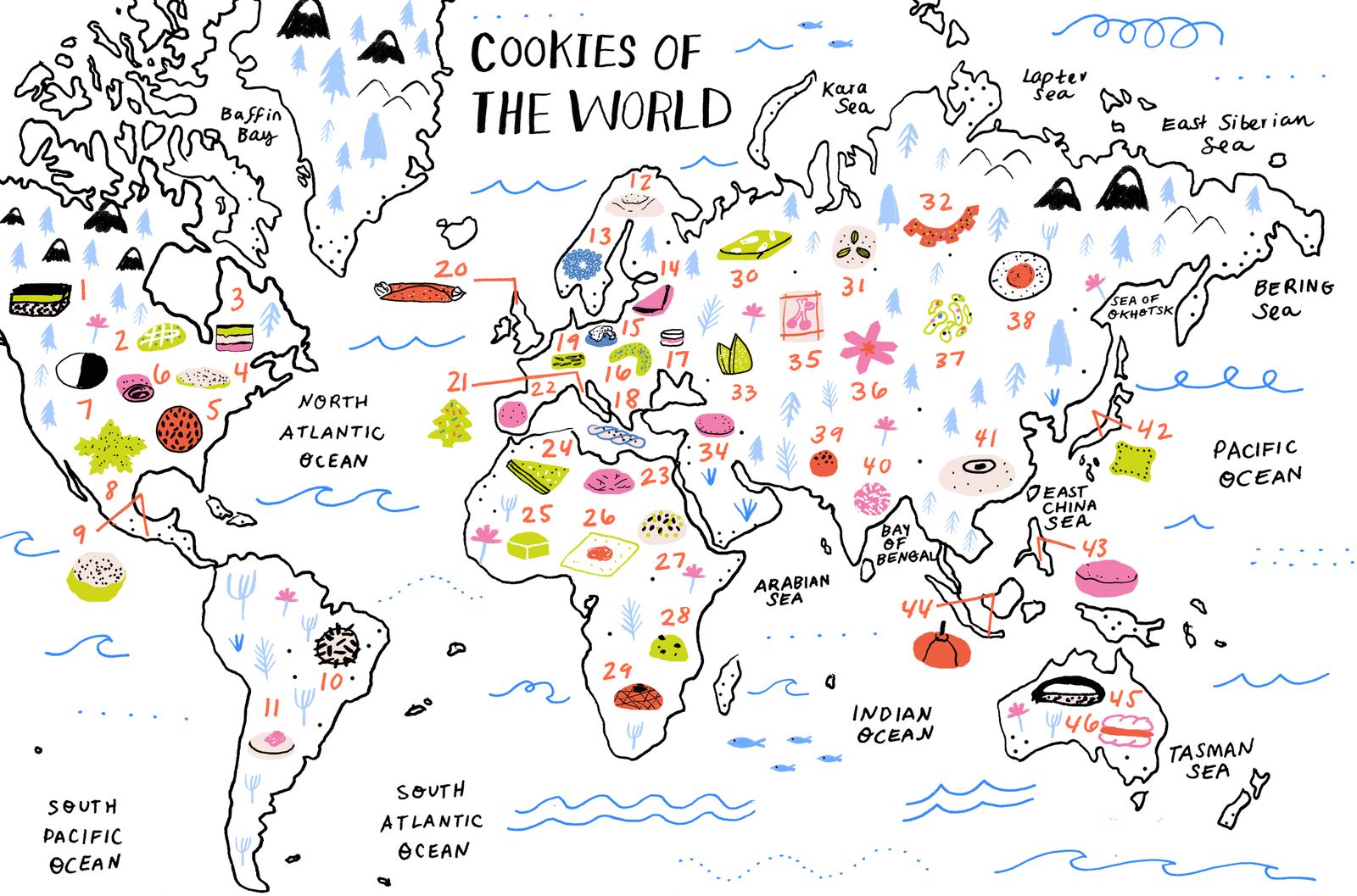
My heart is going to explode with happiness. Food52 just released an infographic (by Jordan Sondler), map, and list with some of the world’s best cookie recipes. I haven’t been able to stop thinking about cookie recipes in preparation for holiday gifts, and now I’m overwhelmed with the urge to retire early and spend the rest of my life baking these iconic desserts. Who needs a PhD? But cookies – oh cookies.
Even better, you can pin your own recipes to a Google Maps archive they’ve started here.
As an American Studies digital humanities/food studies scholar I love this project. The project and subsequent digital discussion speak to the ways that national identity is wrapped up in food. By baking and eating these cookies you can play food tourist at home and consume other national identities.
And all too often many Americans forget how typically American food traditions are not the norm elsewhere. Sascha, a graduate student in Purdue’s American Studies program from Germany, was astounded when attending the first professional development workshop on campus where he tasted a gooey, buttery, M&M-speckled grocery store cookie. “THEY’RE SO SOFT. HAVE YOU TRIED THESE COOKIES? COOKIES DO NOT TASTE LIKE THIS IN GERMANY.” Is it the vegetable shortening Americans add? Or the rainbow of chocolately morsels that makes their taste and texture so delicious? I have no idea. Needless to say, he’s requested cookies or candy at almost every event since.
Here’s a list of 46 recipes Food 52 posted on their site. Where am I going to begin my baking??? Maybe #9 – because who doesn’t want to bake with Tequila!?
Here’s to celebrating a little differently this year.
@RiseandRender’s photo of their thumbprint cookies – a little flatter and crispier than mine but probably equally as delicious. Check out their photos of making Ina Garten’s recipe. World, expect cookie Xmas gifts.
This Thanksgiving was probably unlike yours – calm and quiet with almost zero hustle and bustle in the kitchen. I spent the day making Thumbprint cookies with raspberry/cloudberry jam centers for men at The Sleeping Room (the local men’s shelter in Muncie, IN), before serving them dinner. The menu: from-the-box stuffing, from-the-can green beans, 2 cans cranberry sauce, a dismantled homemade turkey, Sara Lee pumpkin pie, and cookies (my only genuine contribution). When we arrived Betty, the mom in a mother-daughter 2-person team of shelter managers, was sorting through the day’s food donations from Feed My Sheep. What seemed like a bounty to Betty left us confused. Opening the bags we found the offal of pantry discards: 4 jello snack packs. A can of black beans. A package of expired cheesy rice. A can of kidney beans. A can of tuna. A jar of toffee-flavored coffee sweetener. How do you make breakfast and dinner for 10 men every day with these pantry remnants? “We are so blessed,” said Betty. Thankfully the holiday cheer drives a flood of donations, while the rest of the year the shelves dry up.
A snapshot of The Sleeping Room – 10 beds in a studio apartment. The small kitchen and dining room is just behind the camera on the other side of these beds, while the bathroom with shower is down a small hallway. Upon entering you relinquish all pocket contents and bags in exchange for a clean set of pajamas to be worn after your shower and dinner.
The hour spent there was quick but meaningful. We returned to spend the evening enjoying the warm weather by our backyard campfire deep in thought over the experiences of our country’s homeless. What is it like to survive on the streets? How does involuntary urban camping change your daily habits: when/where to go to the bathroom, what counts as entertainment or dead weight, and what types of behaviors (like sitting on a curb or carrying a book bag) while completely normal for many attract unwanted suspicion and attention? How long can you survive being homeless?
Most of all, it made us think how completely insufficient this tiny studio apartment-turned shelter for 10 men was to quell the needs of the local homeless. Elizabeth, a Chicago-area women who recently Airbnb-ed our spare room for a night, told us about her work advocating for Chicago’s homeless population of 140,000. An estimated 14,000-15,000 men, women, and children each day sleep on the streets of Chicago, yet the city provides only 140 beds for the homeless. With the high price of real estate in the city, and more and more middle- and upper-middle class professionals paying high rents to gentrify previously poor neighborhoods, there’s no economic incentive to convert Chicago property into shelters.
Homelessness should not be balanced on the backs of people like Betty and Elizabeth alone. How is homeless everyone’s problem? And how can the solution be the result of everyone’s work? So grab a cookie and let’s discuss.
This is a snapshot of Martha Stewart’s recipe for Thumbprint Cookies, (although I used salted butter and added salt to balance out the sweetness from the raspberry/cloudberry jam). Eat no less than 3 per day.
In November of 2015 I presented my research on Berkeley’s People’s Park at SACRPH – The Society for American City and Regional Planning History. Because the conference was based in LA, many panels that put theorists, practitioners, and historians in conversation addressed local concerns over the right of the masses to the city. One of the most engaging panels included presentations by Cathy Gudis and Eric Avila who, in different ways, evidenced a public visual culture “from below” with rich examples of people staking claim to urban space in LA.
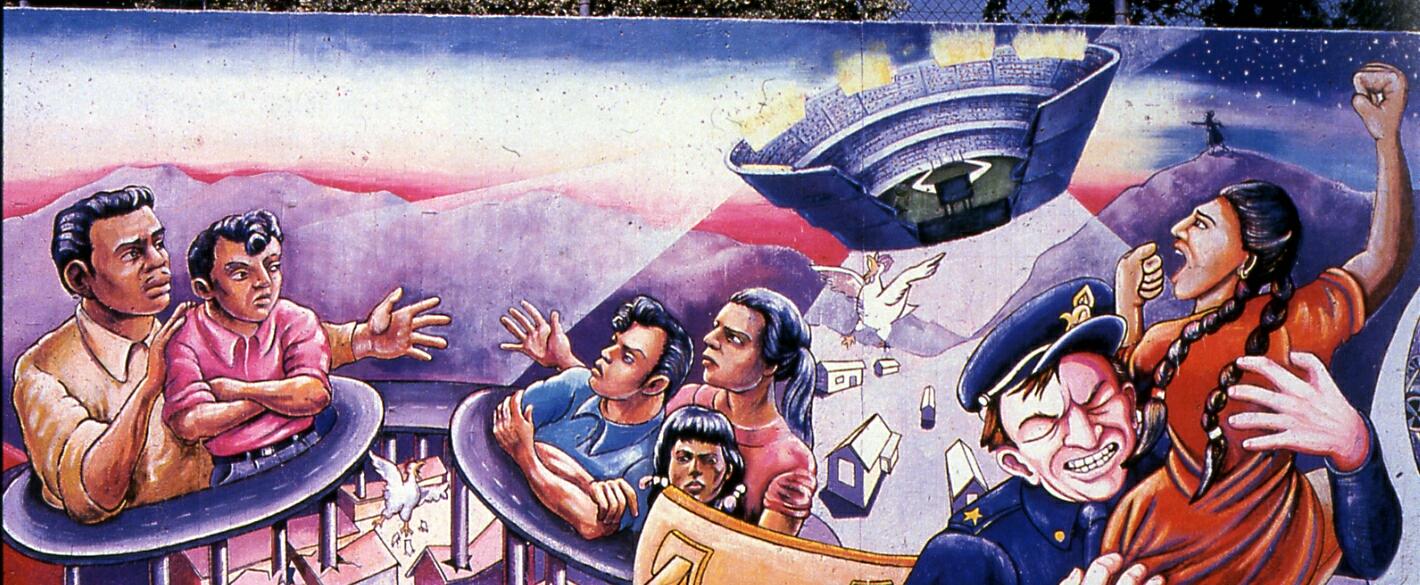
Eric showed his own photographs of The Great Wall – a mural painted on a concrete barrier trailing 2754 feet on Canyon Ave by artist Judy Baca – which offers vivid snapshots in America’s history and experiences of communities of color. More than just acknowledging their existence, the mural captures struggles over power embedded in urban space, such as this segment that portrays how local and state governments backed with federal funding seized land owned by people of color to build highways, universities, and more. This segment shows how the state demolished Chavez Ravine, a Mexican American neighborhood in LA, to make way for a new highway and the Dodger’s Stadium that divided the barrios and fragmented the Mexican American community.
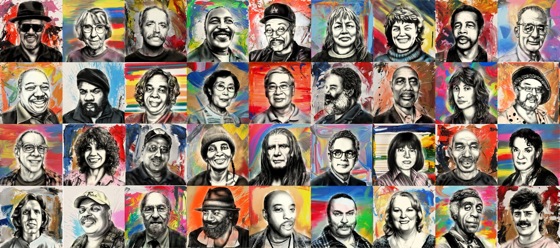
36 portraits of Skid Row visionaries by street artist Mr. Brainwash.
Offering a contemporary lens, Cathy shared her own experiences working with the bi-annual Walk the Talk parade held by the LAPD (LA Poverty Department) in Skid Row – home to the largest homeless population in the US. My own experience staying in Skid Row for the SACRPH conference was eye-opening. I was absolutely stunned at how many people were living on the street in clumped tent cities.
The parade functions as an affront to cultural norms and policies discouraging citizens and tourists from venturing into Skid Row and talking with its itinerant residents. Marchers carrying musical instruments and posters showing the faces of dead and still surviving homeless residents process through the neighborhood. The parade is part of a series of events facilitated by the LAPD that engages the community in discussions to identify initiatives and people who have made positive contributions to Skid Row.
Photo by Genaro Molina/Los Angeles Times, Walk the Talk parade participants march from Gladys Park led by the Mudbug Brass Band and stopping for sketches celebrating local activists.
What events and places in your community highlight the experiences of people of color in American past and present?
Panels at conferences often feel like a hastily assembled mishmash of different things, like a fruit salad made by Mr. Magoo. Scholars who do not know each other and know less about each other’s research work together over email to try to slap together panel proposals that seem just plausible enough to pass muster with weary conference organizers, who have papers to grade, toddlers with runny noses, and annoying emails from students to answer. (In my best John Oliver voice: If the reading is listed next to the class date on the syllabus, you read it BEFORE CLASS on that day Jeremy!)
But occasionally you get to see a panel where all the papers interlock in meaningful and intellectually intelligible ways. In just this fashion, the session “The Unplanned City: Occupation and Creative Reuse” at last week’s SACRPH conference in Los Angeles offered an invigorating and rich perspective on different approaches…
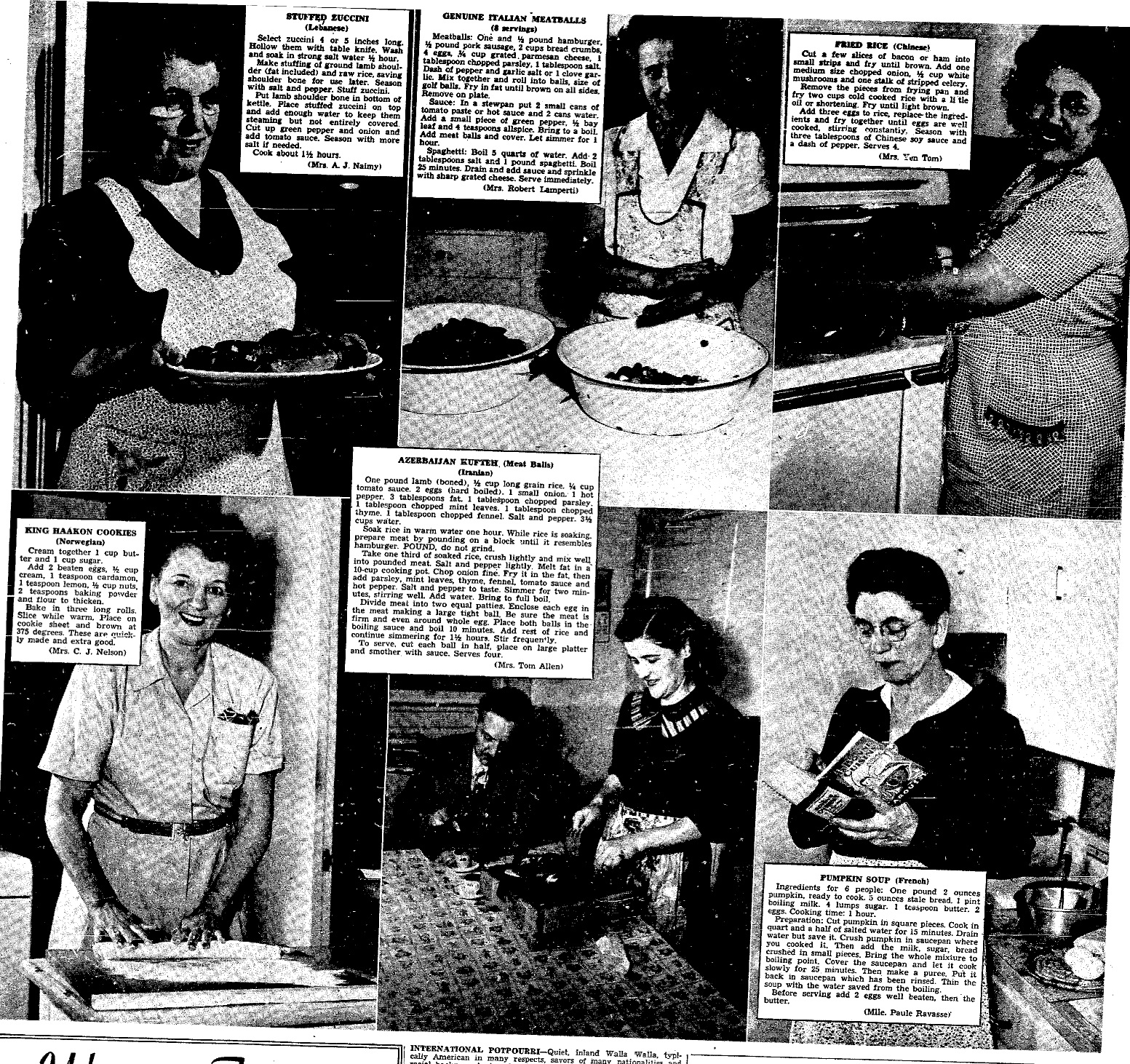
Skip to the bottom for 6 global food recipes from 1950s housewives in Walla Walla.
Meatballs. I grew up eating small, thumb-sized beef meatballs microwaved from their frozen plastic bag and then dumped into a pot of 2 cans of 99 cent Hunts spaghetti sauce. After swirling my fork around a lump of store-brand boxed noodles, I stabbed each juicy meat pocket before adding a final dollop of sauce for a perfect bite. Because a whole bag of frozen meatballs was allotted for a family of five, I had a shot of getting 5-6 meatballs to start me off before grabbing a few more for seconds after the first round. If you were really lucky, there were some leftover store-brand hot dog buns on which we lather Country Crock margarine with our butter knives before sprinkling yellow-dyed garlic salt. It was heaven.
It’s like you’re photographing my memories! Hot dog bun garlic bread, straight from my margarine covered fingers. Check out Near to Nothing’s recipe here.
Frozen meatballs!? Spaghetti sauce from a can!? Store-brand noodles from a box!? No actual garlic!? I hear your criticisms through space and time. No, I did not cut open real garlic until college. Although I didn’t really know it then (and didn’t really know what I was missing since my siblings and I mostly just befriended each other), it was the best my mom could do. Teaching fourth graders from 7-4 PM or later, with three kids plus one adult male child for a husband who worked all day, it was all she could do to make sure we were fed quickly and cheaply so she could get some sleep. And I don’t regret it. This version of preserved, hydrogenated, frozen Italian American food has always been my most favorite meal. Spaghetti and meatballs is the perfect combination of salty and sweet, carb, vegetable, and protein, main course and dessert. It’s good cold or hot. It’s quick and wholesome — comfort food fast.
Sam’s Club meatballs! With a family of five, you gotta buy them in bulk. Check out this recipe for Swedish Meatballs from Laura’s Latest here.
Yet meatballs haven’t always been joyous spaghetti speckles of opulence. At Global Food: Local Perspectives on October 22 at Purdue University, Dr. Simone Cinotto gave an interesting lecture about the myths and realities of Italian American food culture which can be reduced to the transformation of the lowly meatball. Presenting material from his book The Italian American Table, Simone argued that Italian food culture has been mis-remembered as always being rich and plentiful, but that it was instead a post-immigration shift for the majority of Italy’s working-class citizens. Italians who ventured to the US did so out of economic necessity, often shaking out bread crumbs and clinging pots and pans to create a symphony of cooking for neighbors for meals that never existed. Working-class Italian families in the US were able to finally afford rich meats, breads, and cheeses in ways they never could in Italy – ultimately producing a dense and diverse Italian American food culture in New York City and beyond.
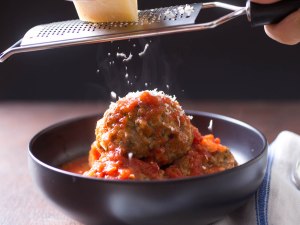
Check out these gorgeous photos by Vicky Wasik who breaks down a recipe from Serious Eats for the juiciest, tastiest meatballs.
Although spaghetti and meatballs is considered a classic Italian dish (perhaps made most pop culturally famous with Lady and the Tramp), large baseball-sized meatballs of pork, veal, beef, and spices haven’t always been a sign of opulence. Meatballs were a working-class tool for spreading meat out farther, stretching the cheapest cuts of ground mystery meat by mixing in nearly equal amounts of bread crumbs to make golf-ball sized polpettes.
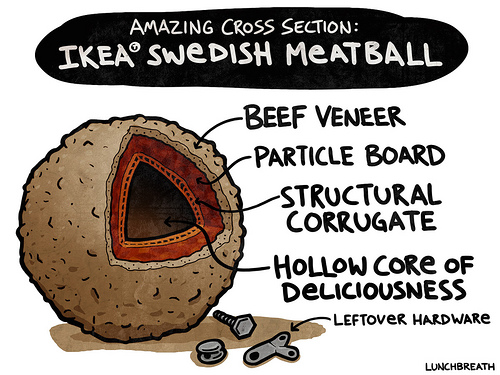
Oh dear, have I eaten some Ikea meatballs in my lifetime.
While more wealthy northern Italians tended to move out to central and western states, southern Italians made landfall in downtown Manhattan within proximity of Kleindeutschland, or Little Germany—an enclave of German transplants settled in the Lower East Side, who ran many butcher shops that sold beef and pork. In Italy, those meats were hard to come by in the south, and usually were accompanied by high prices, so a ready supply of more affordable red meat became a gold mine for the growing Italian population…The meatball-as-convenience-food concept grew steadily through the turn of the century, as more and more of New York and the country settled into a standardized eight-hour workday. With a greater percentage of the workforce—male and female—conforming to a 9 to 5 schedule, pre-made dishes like meatballs functioned as a kind of fast food, especially when loaded into a crusty hero loaf. Reliable, recognizable, and reasonably priced, they made for an easy meal with few strings attached. And along the way they solidified the American understanding of what “Italian food” meant.
So, in practice of Global Foods: Local Perspectives, in celebration of the World Series, and in remembrance of all my delicious microwaved food of my youth, here are TWO recipes for meatballs from Walla Walla, Washington in 1950, along with several other delicious globally-inspired fusion recipes from Cold War-era housewives. Dig in and read Lisa Banu’s coverage of Global Food: Local Perspectives here! More reflections to come.
World Recipes from pg 17, Walla Walla Union Bulletin October 1, 1950
You are invited to attend an important symposium exploring international influences on local food culture. Global Food: Local Perspectives will be Thursday October 22, 3:30-5:30 in NLSN 1215 at Purdue University.
The symposium will feature a keynote lecture by Dr. Simone Cinotto, Professor of Italian American history and food studies at the University of Gastronomic Sciences in Pollenzo, Italy. He will present material from his most recently published book, Making Italian America: Consumer Culture and the Production of Ethnic Identities (2014). Following his lecture, Dr. Lisa Banu (local food/design studies blogger at HungryPhil.com) will lead a roundtable discussion with three local restaurant owners from Thai Essence, La Scala, and Shaukin about their food memories and philosophies. A complimentary food tasting for the first 50 people will accompany their discussion. Visitor parking at PGG (Grant St., West Lafayette).
This event has been curated by Kera Lovell as part of her 2015 Global Synergy Grant. The event has been sponsored by the College of Liberal Arts’ Global Synergy Grant, the School of Interdisciplinary Studies, the American Studies Program, the Italian Studies Program, the School of Hospitality and Tourism Management, and the American Studies Graduate Student Organization all at Purdue University. Thanks to Kirsten Serrano (La Scala), Miinal Bhatt (Shaukin), and Ake Waratap (Thai Essence) for donating their time for this event.













 Kera Lovell, Ph.D.
