The central thread through all of my research is my analysis of the relationship between identity and citizenship — or how we know who we are and how that who we are is regulated. In my dissertation I research how postwar activists understood this relationship as rooted in practices of police violence and urban renewal and histories of colonialism.
Two undergraduate courses I’ve taught in American Studies focus on this relationship between identity and citizenship. My spring 2015 course “Blood, Bones, and Brains” examined twentieth century US history through the lens of the body, and focused on how the body became a canvas for self-definition and regulation. My summer 2015 online course “Youth Cultures” used Tumblr to facilitate discussion about how American youth identity is continually constructed as both youthfully beautiful and immaturely undeveloped.
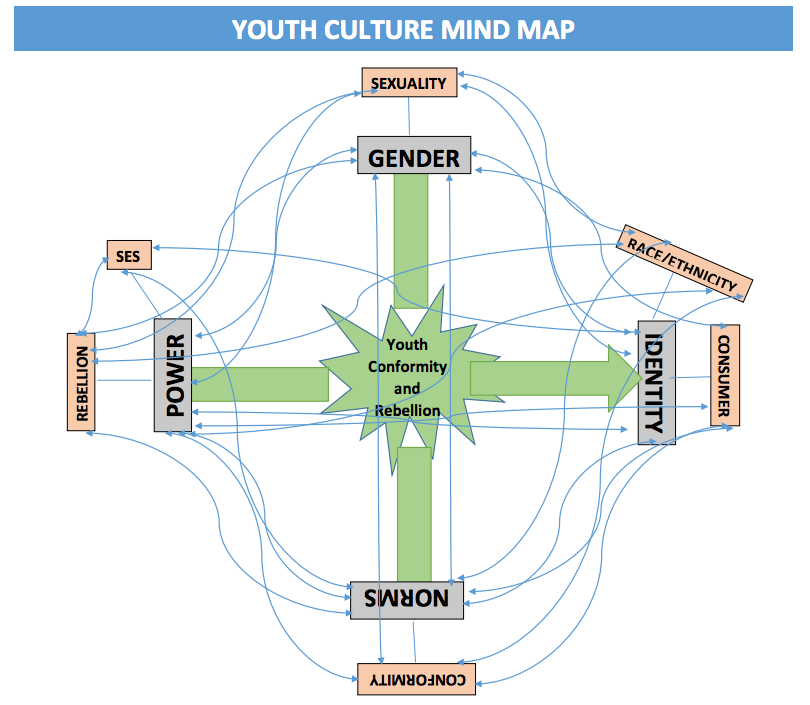
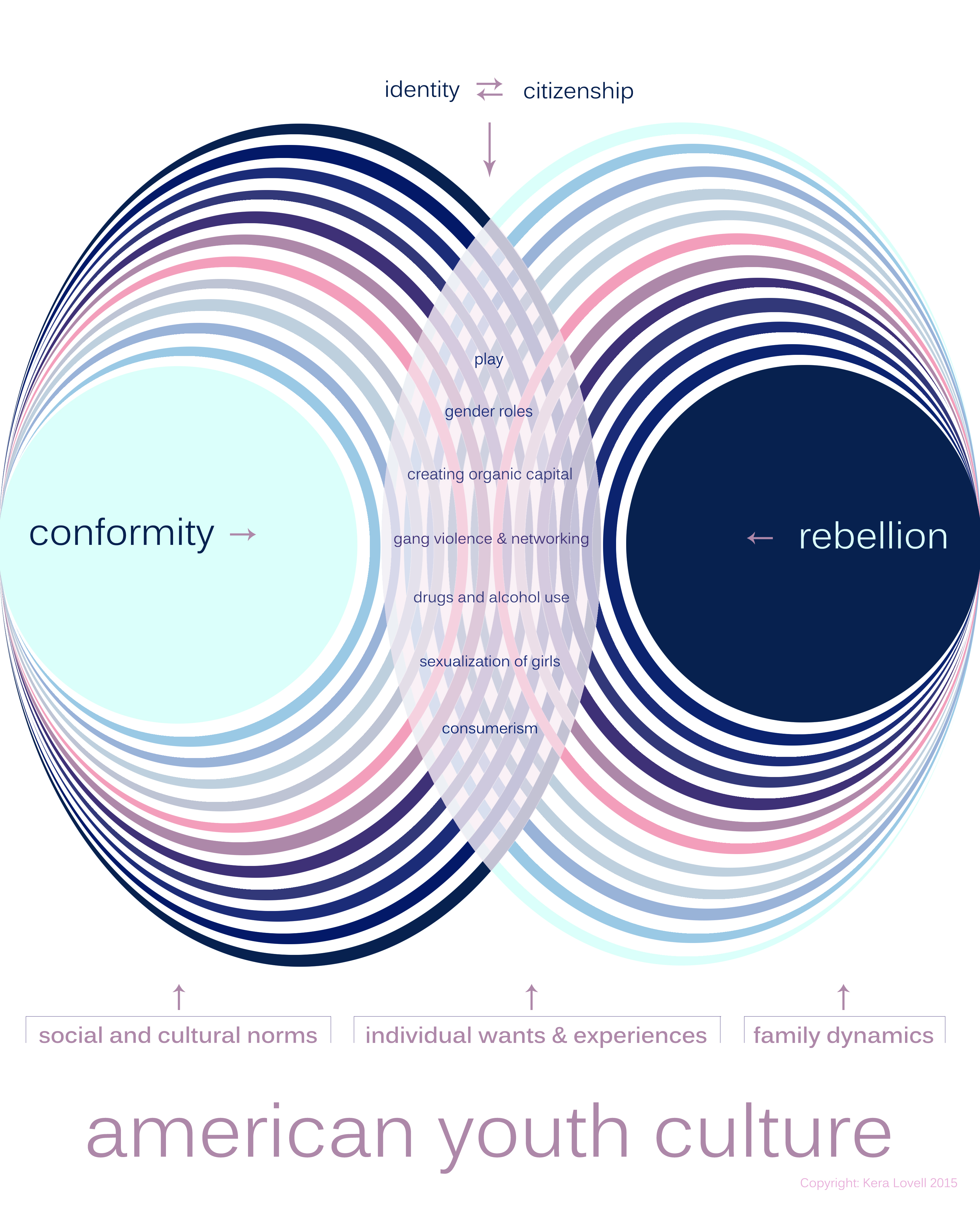
A graphic I made as part of the end-of-the-course “mind-mapping” assignment that asks students to rethink the organization of the course and connect class topics and readings in a new order. In this graphic I depicted the two core oppositional yet connected themes of youth culture — conformity and rebellion. To see more mind maps from the course, check out my Tumblr: http://amstyouthculture.tumblr.com/
Additionally, I’ve conducted research on the high school women’s liberation movement between the mid-1960s and mid-1970s. My paper, “Girls Are Equal Too: Education, Body Politics, and the Making of Teenage Feminism,” published in the academic journal Gender Issues, analyzes how teenage girls began to articulate how their age shaped their unique experience with sexual discrimination. Another version of the article was published in Black Perspectives, the online journal of the African American Intellectual Historical Society.
In particular, in this paper I focus on how teenage girls articulated feminism through their own perspectives and bodies. Letters and essays written by teenage girls during this time demonstrate how girls saw feminism as a tool to challenge gender role socialization and build a supportive and collaborative community of girl activists within this revolutionary context. Ultimately, by challenging age divisions between the adult-dominated face of the Second Wave and the girl-focused Third Wave, this paper uses the voices of teenage girls to shed light on an earlier movement of “girl power” that has yet to be excavated.
This poster was created by See Red Women’s Workshop – a British women’s liberation graphics collective. See this poster and more of their work by clicking on this image.
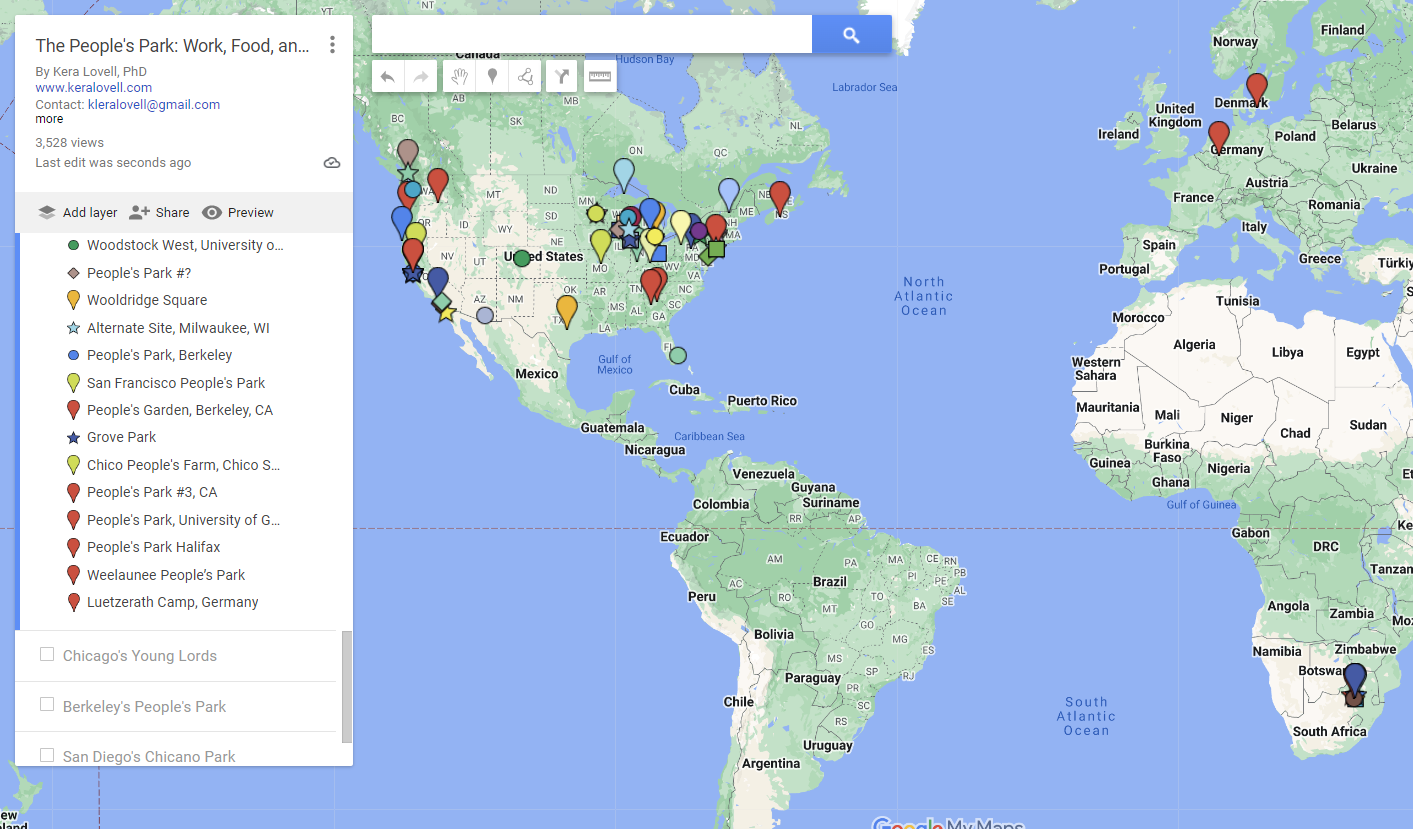
As an expansion of my dissertation, my book project titled The People’s Park: Work, the Body, and the Built Environment in Radical Postwar Placemaking traces the origins of insurgent park creation as a widespread tactic of civil disobedience in the late Vietnam War era. Using oral history interviews and archival research from collections across five states, the book documents how activist coalitions illegally transformed more than forty vacant lots into what they called “People’s Parks” during the long 1970s. In particular, the book project examines how key components of these parks, including food production, landscape design, art, and the underground press shaped activists’ memories of these spaces. Because my research focuses on identity, my work offers an intersectional analysis of these spaces with a focus on race, gender, and sexuality. My articles, “Free Food, Free Space” (American Studies Journal) and “Everyone Gets a Blister” (Women’s Studies Quarterly) both explore women’s work in shaping the visual and material culture of these parks, illuminating how women activists struggled to create space within this largely white male-dominated protest movement. For park creators of color, such as those at San Diego’s Chicano Park to Chicago’s Poor People’s Park, park creation meant challenging police brutality as systemic racism. By putting these park creations in conversation with contemporary protests, my research offers historical perspective to growing protests about the right to space due to continued struggles over urban renewal amidst the growing housing crisis.
In 2020 I was awarded a research grant by the Graham Foundation to conduct an international research trip from Seoul to D.C. to collect archival data at the Library of Congress. This research is in the process of being published in two chapters in edited collections.
As an extension of my dissertation research, my project proposal for the 2015-2016 National Geographic Digital Storytelling Fulbright, awarded semi-finalist, focuses on the relationship between space and power. The project, titled “Grass/Roots,” compares and maps spatial and environmental power by analyzing how people occupy, reclaim, and create public green spaces in South Africa, New Zealand, and the UK. The project combines ethnographic interviews, site and event documentations, weekly self-produced informational graphics, and a cumulative cultural atlas illuminating connections among my case studies and their intertwined colonial histories.
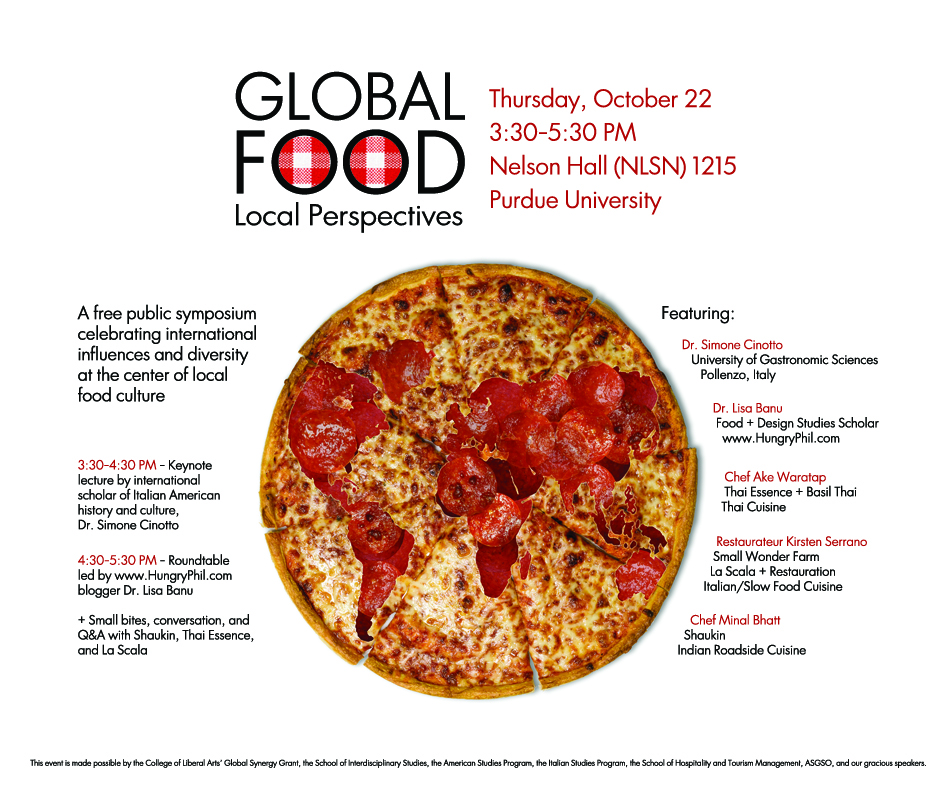
In 2014 I was awarded a $10,000 exploratory research grant to study transnational American food studies at the World Expo in Milan Italy in May of 2015. As part of this grant I worked with Dr. Simone Cinotto at the University of Gastronomic Sciences in Pollenzo, Italy, before organizing a symposium with him as keynote at Purdue University in October of 2015. The symposium, called “Global Food: Local Perspectives,” offers an investigative look into how food production and consumption is transnational — even in West Lafayette, Indiana. Since then, I have integrated food studies into my dissertation and teaching.
The culmination of each class I’ve taught includes 2 connected assignments: the creation of a mind map in which you rethink the topics and organization of the course and a 1-2 page essay unpacking the argument and significance of your map.
(side note: You can check out the course syllabus for AMST 201: Conformity and Rebellion in American Youth Culture on my Academia.edu page here. This 8-week online course was offered at Purdue University in the summer of 2015, and had 12 undergraduate students and 1 Masters student. Most interestingly, it includes the list of readings and films assigned for the course, although I’m always on the lookout for more amazing assignments. Send your ideas my way!)
This visual exercise frequently stumps my students who have never had to create an assignment like this. How can you grade it? What’s the right answer? How will I know if I’m wrong? And all I can say is this: “I want you to be brilliantly original and brief. Show me critical thinking and show me that you engaged with assigned material and discussion topics over the course of this semester.” It’s a lofty goal, but most of the time it really gets students thinking about how to put all of the puzzle pieces back together. It encourages students to think about the significance of juxtaposing these ideas, as well as initiates thinking about what topics or perspectives were left out.
For this course, students were asked to create a mind map on American youth culture and write an accompanying explanatory mind map. I encourage you to check out all of the mind maps on Tumblr by searching for our shared class hashtag #amst201youth. Here are a few of my favorites as well as my own mind map of youth culture.
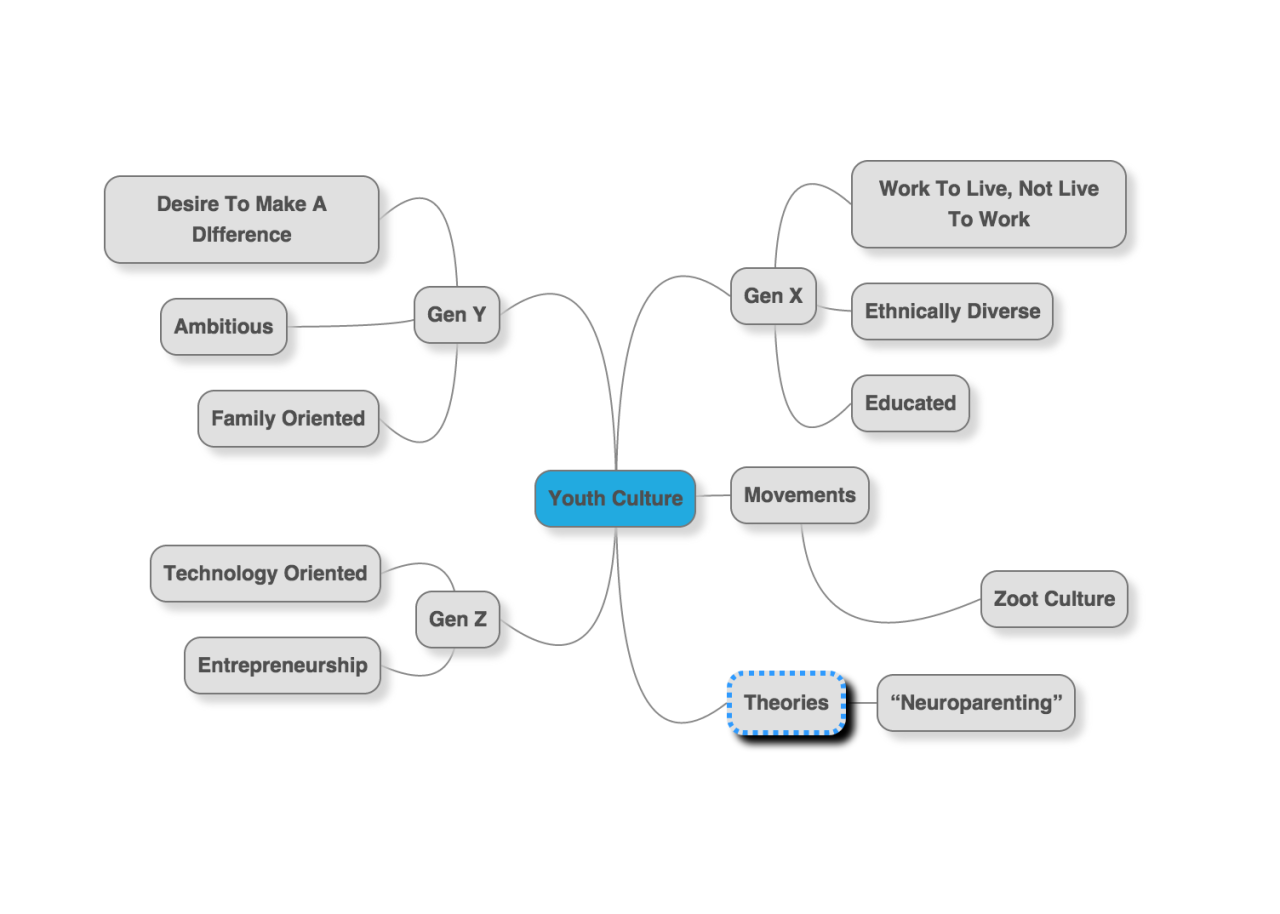
Tylor’s Mind Map, produced as a final component of his participation in AMST 201: Conformity and Rebellion in American Youth Culture in American Studies at Purdue University, 2015.
In his mind map, Tylor broke down the course chronologically by generations (which offered an interesting counterpoint to the course which was organized thematically and jumped from past to present). Readings or films on each generation indicated distinct characteristics. He argued that Generation X was ethnically diverse, educated, and “their generation worked to live, and they didn’t live to work.
This generation was the first to not have to live through the segregation and the Civil Rights Movement.” Generation Y is family oriented, ambitious, and desires to make a difference. He adds: “This generation is the generation that are into tech, like the software developed today, is the result of this generation, their ambition and desire to make a difference. This was also the generation that experienced the zoot culture. This culture was a good topic in this class, because it showed how different cultures were adopted by teens in order to make themselves more comfortable.”
Finally, Generation Z is focused on technology and entrepreneurship: “Today’s youth are the ones we see with all the new iphones, ipads and all the social media account, such as Instagram, YouTube, and SnapChat. We don’t know everything about this generation, but it’s gonna be something exciting for us to experience.”
Destiny’s mind map for AMST 201: Conformity and Rebellion in American Youth Culture in American Studies at Purdue University, 2015.
Destiny chose Prezi as the medium for her mind map, so I encourage you to check it out in order to see it in a better quality. Destiny chose to construct her mind map on four stages of being in youth culture as seen through the eyes of youth. In her explanatory essay, she writes about the different sections:
“WE ARE GROWING represents the things that youths develop as a result of the environment they are placed in. Like the LA/Salvador, and Dummy Smart articles, youths grow, usually against the grain, and begin to develop their own identities based on the geographic and social location they are in. Usually, they develop a culture and a lifestyle that they can fit themselves in after being rejected by ‘normal’ society.
WE ARE CHANGING meant to represent the different paths that demographically diverse youths take. Some allow themselves to fall into the socially constructed system, while other don’t. Like the podcast on Hispanic youth and the documentary Teenage, new communities, identities, cultures, and social norms can arise when enough regulative pressure is applied to youth populations.”
See more of Destiny’s excellent work at her Tumblr site here.
Ariel’s Mind Map for AMST 201: Conformity and Rebellion in American Youth Culture in American Studies at Purdue University, 2015.
Ariel’s mind map is broken into four poles: norms, power, identity, and gender (nearly every one of Ariel’s posts offered a thoughtful feminist analysis of gender, so check out her work here). She gives a spectacular analysis, but I’m going to only focus on one of her points to give you an incentive to check out her full essay on her Tumblr. Ariel argued in her essay that visible aspects of one’s identity (like gender, sexuality, and race/ethnicity) shape how the individual is perceived as connected to power and expectations of conformity.
She writes: “As discussed in numerous articles, a person’s race/ethnicity are often a source of power imbalance. As is seen not only in the articles but in everyday life, if you are a part of the mainstream society you tend to have more power in general while being a member of a minority group automatically grants you less power. From this imbalance of power stems the concepts of conformity and rebellion.
There are those who though they do not necessarily agree with the imbalance of power, go along with or conform. Then there are those who rebel against the power imbalance in whatever way they can.” Ultimately, you can never resist both forces of power and identity, the visibility of your identity (race, gender, sexuality, and even class) and the cultural norms granting certain identities more power. These forces exist together in an electrified web.
My (Kera Lovell’s) mind map for AMST 201: Conformity and Rebellion in American Youth Culture in American Studies at Purdue University, 2015.
I pick up Ariel’s argument in my own mind map for the course. In thinking about how to visualize the theme of youth culture I couldn’t get away from the course’s initial organization around two oppositional yet overlapping poles: conformity and rebellion.
This course really interested me over time because it revealed how the central themes of youth culture revolved around how teenagers exist in a liminal state – youths are celebrated as beautiful, idealistic, pure, adventurous, and youthful, while they are also denigrated as naive, self-absorbed, dangerous, vulnerable, and juvenile. Youth culture holds so much power and yet youths are given very little citizenship except for the right to (and expectation to) consume.
Conformity and rebellion are shaped by social and cultural norms, individual wants and experiences, family dynamics (and I would add, historical context), shape behaviors and identities of American youths. These two tensions between conformity and rebellion shape the essential relationship between identity (who am I and what does that mean?) and citizenship (what power do I have and how are my rights valued in society?). Nearly every example we encountered in the readings or films demonstrated how youths in ways that both conformed and rebelled.
Miss Representation demonstrated many girls conformed to cultural norms of female sexualization and infantalization by sexualizing themselves. To engage in this self-sexualization is an act of conforming to norms of women’s sexualization in such a way that presents this self-sexualization as an act of rebellion. Likewise, in the chapter “Dummy Smart” from Victor Rios’s book Punished, Rios argues that young black and Latino boys engage in practices of creating organic capital in an attempt to define their own identity in positive ways that both conforms and rebels – such as wearing expensive tennis shoes to a job interview. These attempts, however, are frequently misrecognized as being lazy or disrespectful that, in turn, further reinforce negative stereotypes about youths of color.
Don’t forget to check out the syllabus on my Academia.edu page or check out amstyouthculture.tumblr.com to see more of our discussions throughout this extremely brief yet fun course on youth culture.
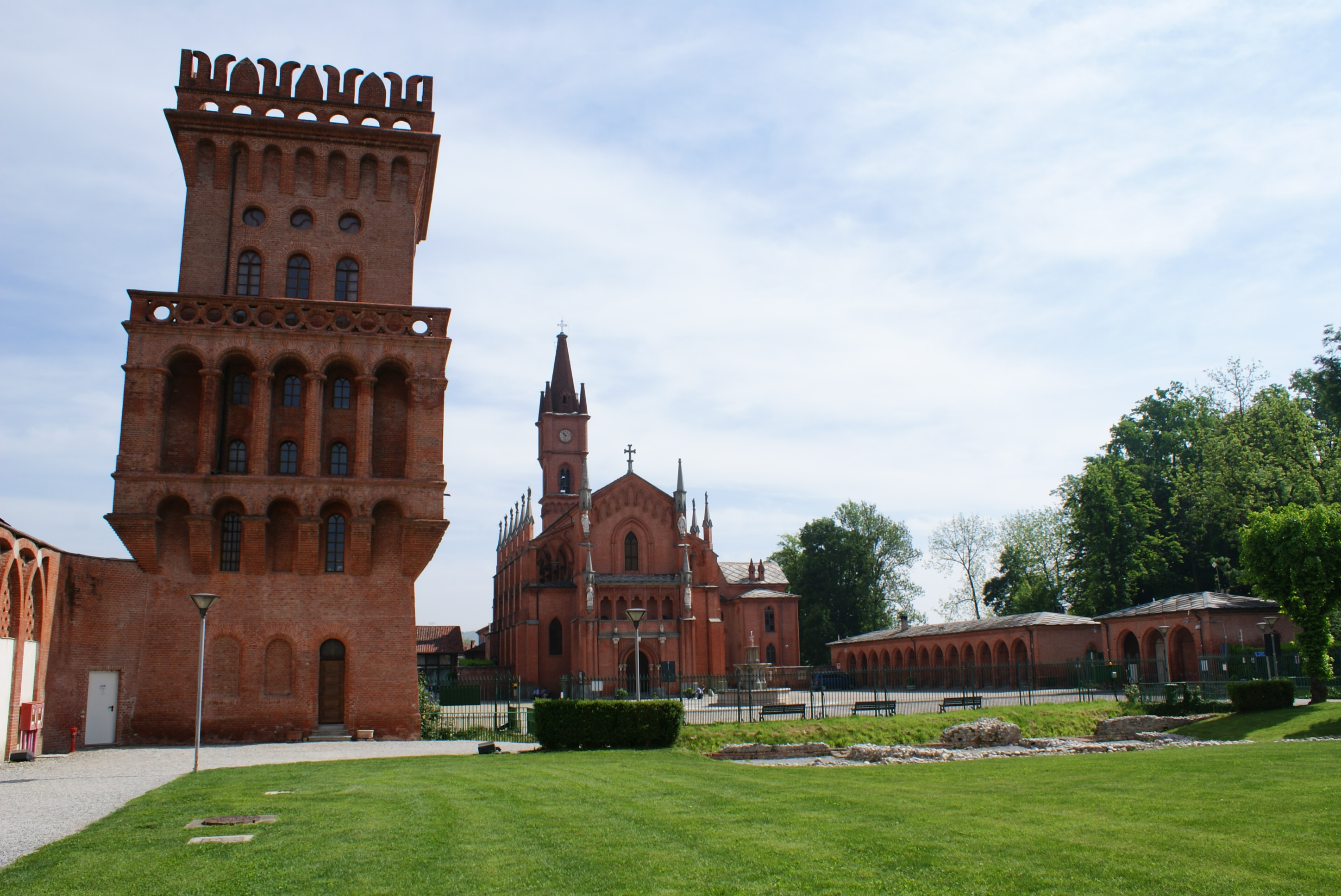
The University of Gastronomic Sciences in Pollenzo, Italy: This is an aerial view of the grounds which includes a hotel, Slow Food International’s offices, and the University of Gastronomic Sciences. Could you tell it used to be a castle? Check out the hotel here (where this photo is from): http://www.albergoagenzia.com/welcome_eng.lasso
My second stop after visiting my faculty advisor, Professor Simone Cinotto, in Torino, was visiting the University of Gastronomic Sciences in Pollenzo, Italy. As you can see from the photo, there’s just about nothing in Pollenzo except for this gorgeous castle-turned school/hotel, a scattering of homes and businesses to the right, and miles and miles of farmland and agritourism sites as far as you can see. When I asked Dr. Cinotto to recommend a good place for lunch, he only suggested about 5 great farm-to-table restaurants within a half hour (and Italians are not easy to please when it comes to food).
Here is a plaque detailing some of the historical roots of the castle at the university. Towering above is the campanile or bell tower (often located at the historic city center), shown above.
Fortunately I was able to spend the night in Bra with a graduate student at the university from California who is (at this moment) doing her required internship at an organization in London. She took about 2 hours to give us the inside scoop on the school, describing how the course schedule works, types of classes offered and the ones she preferred, and the city in which she lived. For example, in the university’s undergraduate program seen here, the course schedule includes a range of classes, from Sensory Analysis and Microbiology to Territorial Sociology (<–??).
Inside a classroom at the University of Gastronomic Sciences in Pollenzo, Italy where you get to taste the food and eat it too!
In addition, programs include required food studies field trips to events in Bra and neighboring cities, another destination in Europe, and then another outside of Europe. The school is hard work, don’t get me wrong, but for lunch you get to eat fine Italian cuisine made by aspiring chefs in a gorgeous castle. That sounds awesome.
A look outward from the University of Gastronomic Sciences which is now a UNESCO World Heritage site because it was once the Royal Palace of Savoy: http://whc.unesco.org/en/list/823/documents
Although this young and selective university has only gone on to graduate a little more than 600 students since its beginning in 2004, the school has produced major talent. I would personally like to vouch for two young vibrant graduates, Anna Bellotti and Grégoire d’Oultremont, who opened their beautiful restaurant L’Alfieri in Bra. It’s intimate and modern, yet fun and colorful with an ever-changing menu and a chipper bartender that greet you upon entry (and offered us up some special cocktails which now have me putting black tea in every liquor). Here you can read an adorable interview with them about why they decided to open their restaurant.
A super awesome photo that I did not take from Trip Advisor.
It was one of the best – if not the best – meal we had in Italy, so I highly recommend it. Here is a beautiful mind map of the owners that I had to share, which highlights all of the intricacies of the restaurant, their quest to create a community-minded space that feels right to be there, with a strong professional backing that rigorously plans, sources, and funds their creative ideas. And if I can find pictures of the food I ate that night, you all will be the first to see them.
Last but not least, here are some final shots of the university before I headed on my way to Parma. Soak in its red brick archways, trailing vines of ivy, and gorgeous views and circulation patterns. What a university. By the way, interested in going there? Check out the university’s website here or go crazy – apply for the university’s Fulbright and earn your MA from there in 1 year for free.
I’m teaching an American Studies course this summer on conformity and rebellion in youth culture. A major component of youth culture in America over the past century has been the near constant creation of new toys.
An assignment for the course was an investigation of America’s toy culture, and included two parts. Part 1 asked students to dive into an experiential analysis of a chosen toy by thinking about what the toy means for youths in our culture:
Toy Paper: Toys are an essential component of youth culture in modern America and, as argued by Roland Barthes, “toys always mean something, and this is always entirely socialized, constituted by the myths or the techniques of modern adult life.”
First, read this excerpt from Roland Barthes’s Mythologies on toys.Choose a toy from TIME Magazine’s “100 Greatest Toys” list released prior to the 1990s, and write a 250-word paper in which you put that toy into conversation with Barthes’s argument. Visually analyze the toy – how it looks, how it moves, what it says, the target audience, marketing strategies, etc. Describe the experience of playing with that toy and the meanings and myths it reinforces (you might want to visit your local toy aisle and make a purchase). Post your response along with a Youtube video or image of an advertisement for that toy on your Tumblr. This advertisement should be a primary source and not a secondary source. Hashtag it #amst201youth #amstpurdue #amstproject
Second, students were asked to jump to current day to investigate the labor behind the toy. How does these toys, mere material objects, claim space in hidden, global ways?
Students are asked to choose any toy out on shelves today and investigate how the toy is constructed. Where is the toy made? What is its path to arrive in a store in the US? How is the toy made? What is the experience like for workers making this toy? Post your 250-word paper along with at least 2 sources (not Wikipedia), and a photo or video depicting a worker constructing/holding the prepackaged toy on your Tumblr using the correct hashtags.
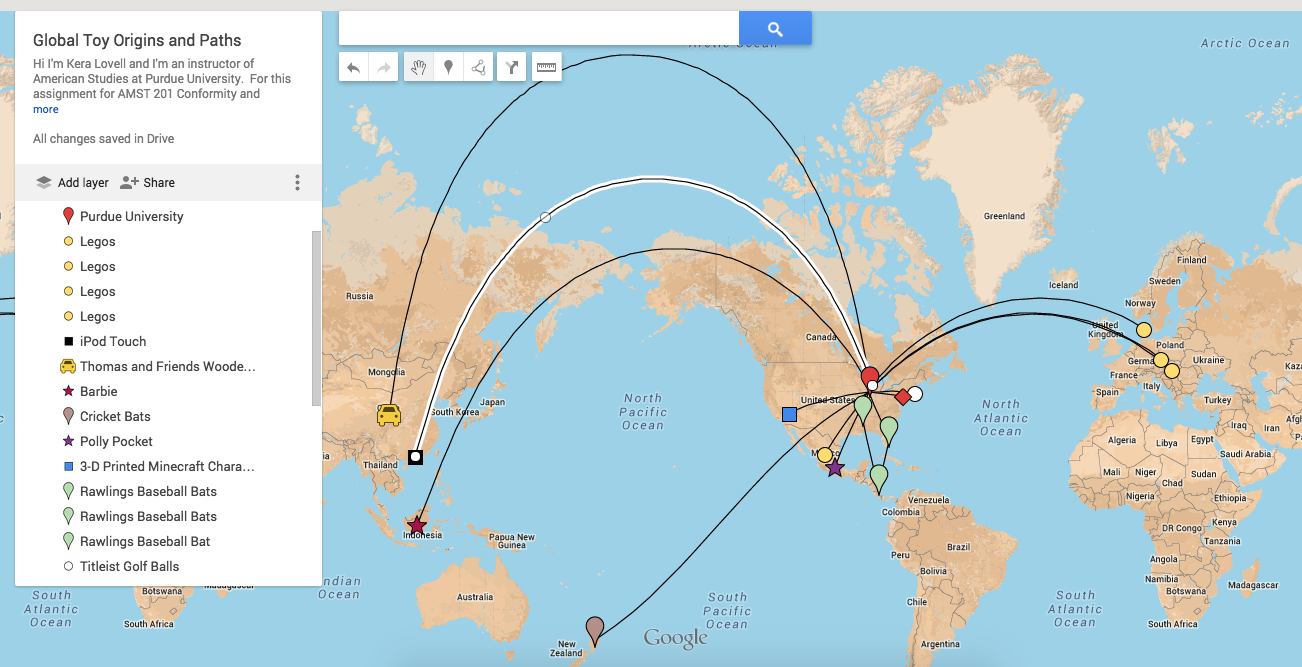
Because most Americans never realize the often multi-thousand mile journey a toy has to make before it is gender-segregated on WalMart’s toy shelves, I had hoped that students would particularly reveal transnational trade routes. And I was thrilled with the response! To visualize this, I composed a Google Map with markers and paths from their factory locations to Purdue University, where the class is offered. Take a look:
A map I created to visualize how many of America’s toys originate, trade hands, and cross maths around the world.
What’s your favorite toy and where does it come from? How can we learn about our global patterns of consumerism by tracing the factory-to-store paths of our most treasured toys? My sister’s childhood favorite was the the troll:
Interested in learning more about our course? Follow the hashtag #amst201youth on Tumblr or check out my instructor blog for the course here: http://amstyouthculture.tumblr.com/
Part of my grant included my meeting and networking with Dr. Simone Cinotto, Associate Professor of Modern History at the University of Gastronomic Sciences in Pollenzo (a food studies university run by the farm-to-table organization Slow Food International).
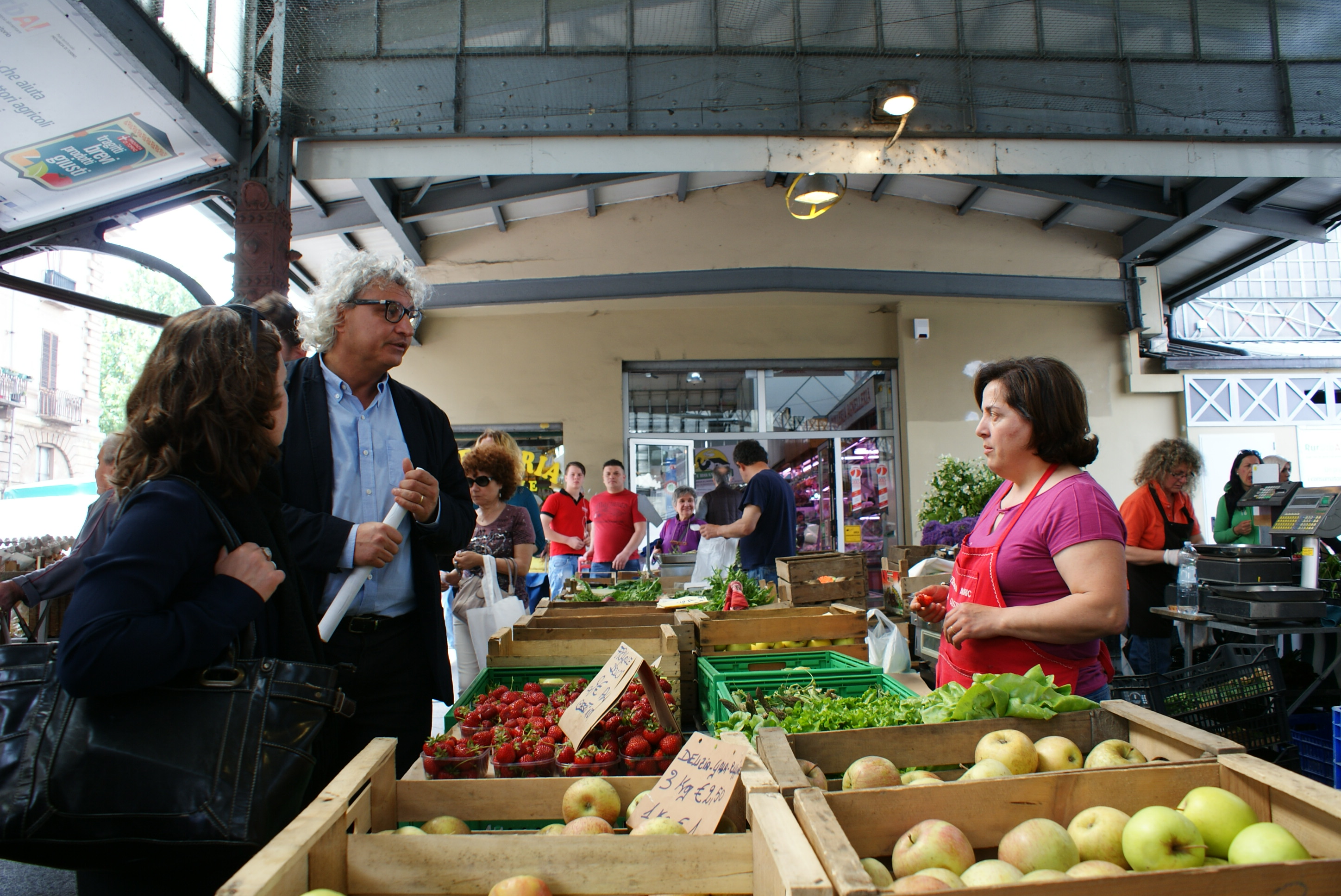
Dr. Cinotto arguing with a woman (who argued back) about the most recent year one could buy a pet at the market. I stood by attentively….
Fortunately (!), Dr. Cinotto suggested we meet in Turin at Porta Palazzo – the largest open-air market in Europe. Needless to say, I jumped into my rented Fiat and sped through crimson poppy-lined toll roads to make it there! His instructions were simple:
Dear Kera can we meet at the corner of via Milano and Porta Palazzo (Piazza della Repubblica) at 11:00 am Friday? I trust you can find the intersection I am talking about on Google Maps. If you think it’s confusing let me know and we’ll choose another location.
I am 52, 6 feet, big, white hair, and black-frame looking glasses.
I responded:
Perfetto! I am 5 feet, very pale, am blind but wear contacts, and speak terrible Italia-ish, but I have seen your photo enough on various websites that I should be able to hunt you down.
See you soon e grazie!
And did I get lost? No sirr-YES. Yes, I got lost. But luckily not too lost before I found him waiting patiently at one of the market’s busy entrances. But I did spot his sterling gray locks from about 300 feet away (be impressed).
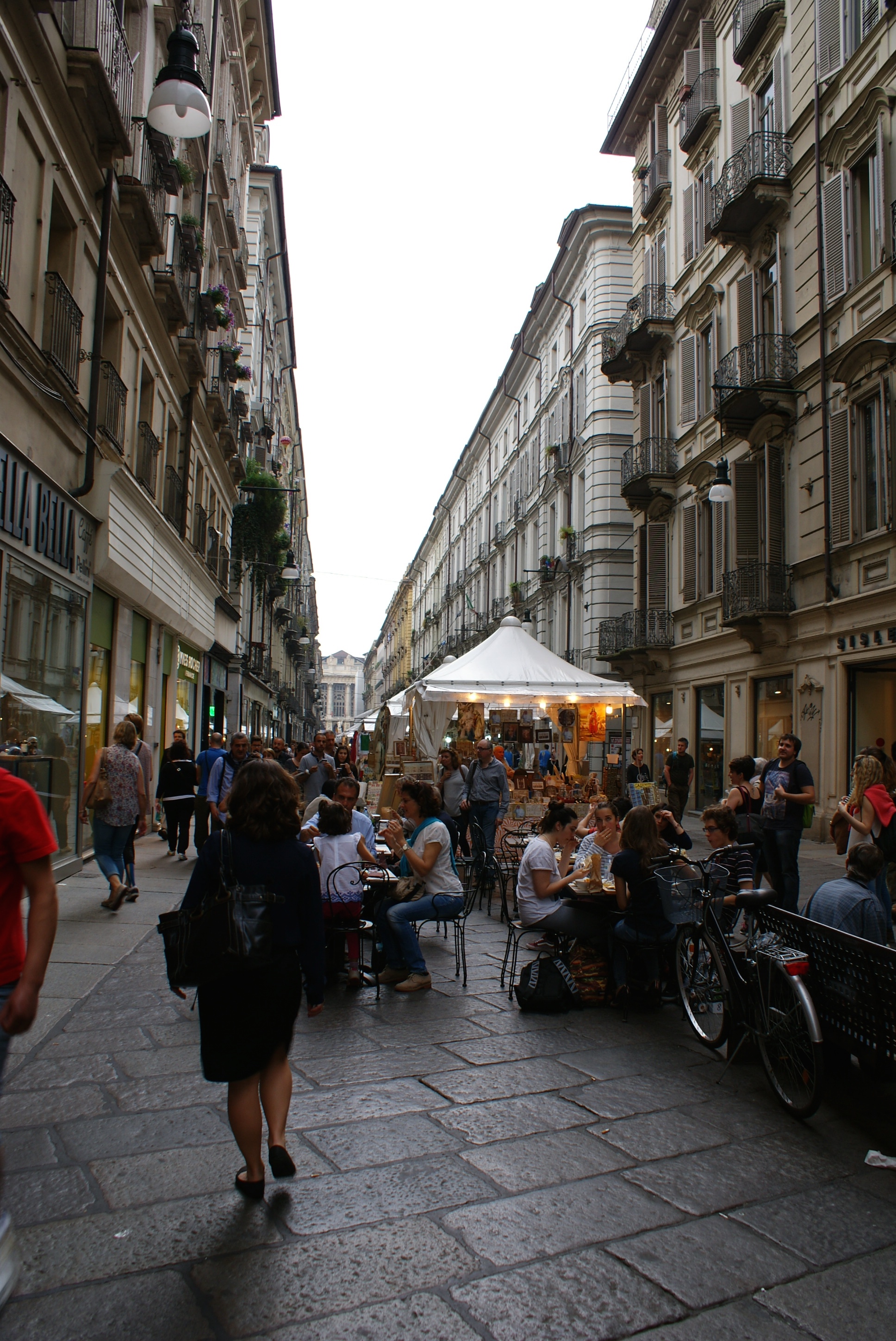
The rain-soaked streets of Turin – did I mention it rained that day? What a great city to get some rain.
I apologized profusely for our delay, and he did what any Italian professor does best – he graciously extended, “Piacere” (nice to meet you), and dove right into a delightfully interactive lecture on the history of the market while we meandered through the vibrant tightly-wound alleyways of market stalls. No time to stop and smell the roses though, since the pace moves rapid-fire, requiring you to “throw up ‘bows” to make it out of there with your wallet.
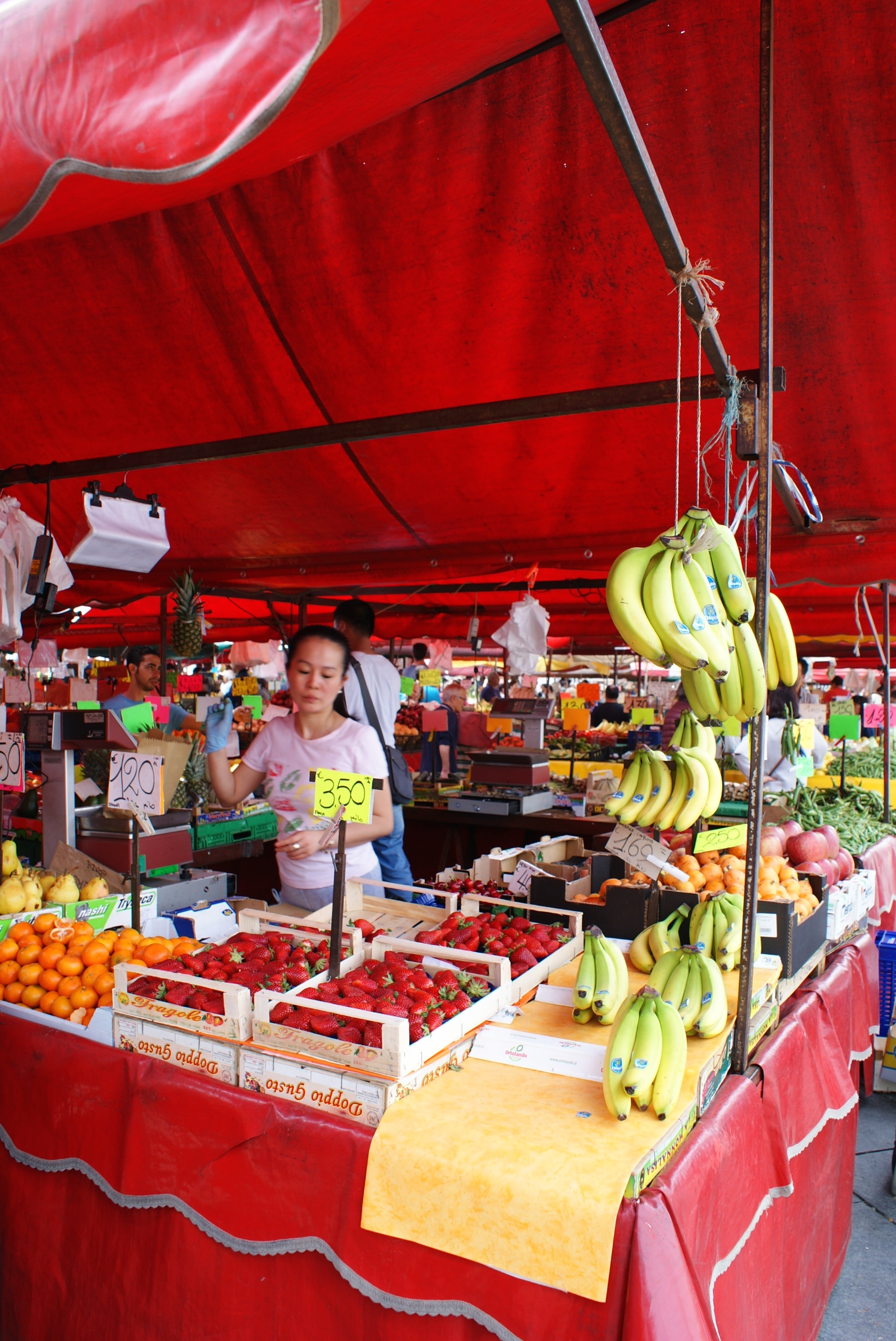
Colorful fresh fruit at discount prices – all at your fingertips.
The market is HUGE, with more than 50,000 square meters, which works out to about a bajillion feet. You can find more pictures and a brief history at The Wandering Epicures (this blog particularly emphasizes the fine meat selection available there). Most importantly, what I learned was that the history of immigrants is essential to the food history of Italy. You should actually check out Rebecca Black’s book Porta Palazzo: The Anthropology of an Italian Market, which Dr. Cinotto highly suggested I read to fully capture the rich cultural diversity of one of Europe’s main commercial spaces.
See those tiny squares? Those are food stalls that spread far and wide, inside of buildings and outside. (Photo courtesy of Wikipedia)
Needless to say, I didn’t buy anything 😦 There were too many choices and not enough time (since the market closes by about 1 PM). You should definitely go!
Simone and I walking through the fish market inside Porta Palazzo
To begin, I want to start by connecting you with my other blog, Global Food Studies, in which I unpack my exploratory research trip to the 2015 World Expo in Milan, Italy where I analyzed transnational American food studies. In this post, I include graphics just released that visualize Dubai’s plans for its own World Expo in 2020. This is a complex infographic, and attempts to visualize three pillars of mapping that I seek to implement in my research and teaching: mapping arguments, mapping primary sources, and mapping constellations. On the left, the graphic uses world and regional maps to geographically pin point this event at the center of both the world and the region. Second, the graphic utilizes a partial aerial view to provide an overview of the park’s components, using scaled images to illuminate proximity of these components to one another. Third, on the bottom, the infographic uses photo-like renderings to provide snapshot stills of the park on the ground to shed light on the experience of seeing and being in the space at that given moment. Finally, on the right, the infographic uses graphics to unpack the park’s thematic layers while showing connecting threads between the park’s structures and its conceptual framework.
In a spark of pure wonderful coincidence, I stumbled across the concept visualization of Expo 2020 in Dubai – and boy does it look amazing, so I wanted to share.
To begin, Dubai’s Expo abstract theme, “Connecting Minds, Creating the Future,” is organized into three main sub-themes: mobility, sustainability and opportunity that are visualized by three main plazas at the center of the park, shown here:
In contrast to Shanghai’s Expo park which was organized similar to the block patterns of New York City, and Milan’s Expo park which was generally organized chaos, Dubai’s Expo is organized with a strong center complex that serves as the heart of the park, housing shared pavilions for entertainment and commercial and diplomatic networking.
As demonstrated by the visual, these three plazas are supported by a dynamic structural architecture that directs airflow and traffic to the three corners of the park. (This is really going to come in handy when tons of people are saturating the park’s core in search of shade on those scorching summer days in the desert sun. Dubai Expo, if you’re listening, you should have some walk-through misters like Disney World. That’s all I’m saying….)
The map of Shanghai’s Expo, 2010, which reveals how the park was organized along main lines of circulation
Expect more details in the future breaking down the map, design, and concept of Milan’s Expo for 2015.
In honor of American Independence Day, I wanted to give you some details about the US Pavilion at the Milan Expo! In contrast to the USA pavilion at the Shanghai World Expo in 2010 (I’ll give you a better comparative study another day), this pavilion not only has corporate sponsors but also government funds which enables more creativity and flexibility in the design process. The building’s design – a very simple two-story building with a linear stacked design – boasts one of the world’s largest vertical gardens that flex horizontally to catch the sun’s rays. Designed to mimic the structure of a barn, the pavilion’s theme of “farm to table” food is part of the US’s mission to work with companies and nations to use simple farming, good nutrition, and agricultural engineering to feed the world’s 9 billion people by 2050.
A rendering of the USA Pavilion at the World Expo in Milan, with one of the world’s largest vertical gardens
Follow the USA pavilion on Instagram @usapavilion2015 to see today’s US-sponsored events – today they have marching bands, cheerleading, flash mobs, and cupcake sales in honor of the 4th. On their Instagram account you can also see a super quick behind the scenes look at the US pavilion.











 Kera Lovell, Ph.D.